
Restrictions on safer supply of drugs will 'drastically decrease' clients: former PHO

Updated: Dec 12, 2025
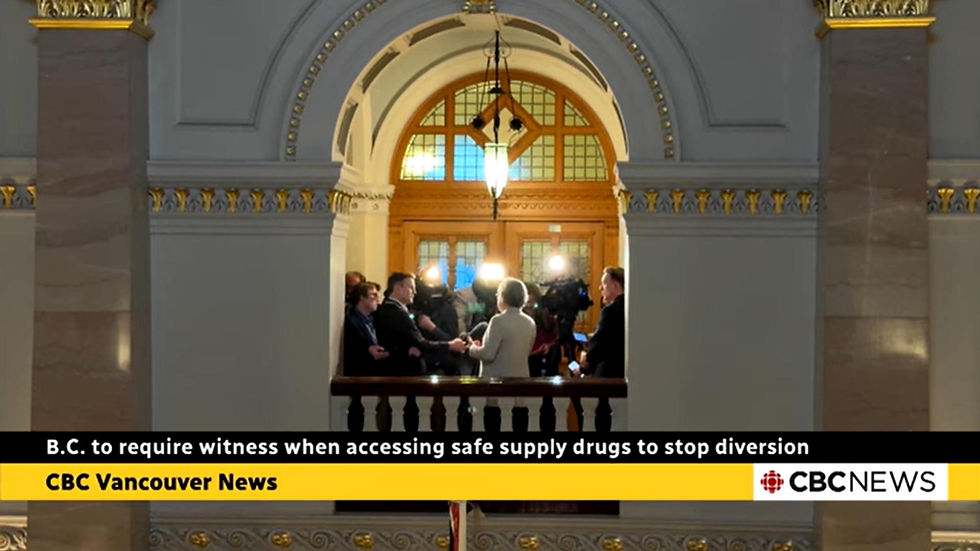
December 5, 2025 CBC News On The Coast with Gloria Macarenko Earlier this week, the B.C. government announced that all patients receiving a safer supply of drugs will be required to have a medical professional present when using drugs in a bid to stop drugs from being diverted to the street. Dr. Perry Kendall, the former B.C. public health officer that declared the toxic drug crisis a public health emergency in 2016, says the witnessed consumption model will drastically decrease the number of drug users willing to participate in the program. He also said he doubts diverted drugs from the province's program constituted a significant amount of the street supply.

Transcript: "Well, I mean, a couple of observations." Says Dr. Perry Kendall, the former B.C. public health officer. "One, I think that the number of people who receive drugs under the safer program is already less than half of what it was at its peak in 2023. So, it's just over 2,000 people. and my guess is that it will it will stop or certainly diminish this program's drugs being diverted to the streets."
"I think it'll also drastically decrease the number of people who are willing or able to participate in the program because it's a fairly substantial hurdle to find someone who could find a health professional who is willing to observe you taking your safer drugs maybe three or four times a day and as we know, a number of people are taking them particularly later in the evening
to sort of stave off withdrawal overnight."
"I think that'll be even more challenging. So, I think it's going to reduce the number of people in this program significantly. I'm not sure it'll have much impact on the on on diverted Dilaudid or imported Dilaudid or non-pharmaceutically made Dilaudid. I rather suspect that this is a relatively small amount of diversion when compared to the total amount of Dilaudid that's probably available on the streets and has been for decades."
Gloria Macarenko asks, "Well, how much of an issue do you think diversion is overall? The government was certainly getting a lot of pressure over it from from the opposition."
Dr. Kendall responds, "Well, it would appear that at its peak there may be quite a lot of it being
diverted, organized crime moving into it, I heard reports of of pharmacists unethically diverting the drugs and then moving them into into the black market. Certainly we heard a lot about that. We also heard concerns that young people who have been dissuaded from using the street drug market because of its danger were thinking these were safe drugs and they could use them and have the experience. And we had some anecdotal reports of them becoming addicted which I think is the one that really raised the panic around diversion; the fact that prescribed medication was being diverted and people who otherwise mightn't have used those drugs are now using them and getting into trouble."
"I think that shifted the political environment and made it this became the focal point of a program that we actually know from evidence was actually saving lives and keeping people away from the illegal drug market and potentially bringing them into a more health oriented or even perhaps a methadone or a buprenorphine based treatment program." (Note: Buprenorphine is the active medication in Suboxone, Subutex, and long-acting injections like Sublocade.)
Gloria Macarenko then asks, "Well, let's talk about more shifts over time. I mean, since 2016, when you declared that public health emergency, how would you say that the conversation around illicit overdose deaths and BC safer supply program? How has that changed?"
Dr. Kendall responds, "I think over this decade, we've seen a number of things. We we first of all
saw a really increased focus on stigma and the stigmatization of people who use drugs and some very powerful campaigns against that. We saw a lot of compassion for those folk who had these problems and increases in access to treatment and better evidence-based treatments being put into place as well." "I think recently, however, we've seen a bit of a backlash against against harm reduction and a move to focus away from harm reduction but more into the the the law enforcement side, treatment side, and even mandatory treatment, which I can understand, but it isn't an either or. "I think if we're going to approach a complex problem, it's probably going to take a fairly complicated group of solutions. I think we need to have another conversation if we can about Canada's drug laws and why they seem to be so paradoxically harming people that they were supposed to to help. I think if we could step back a pace, forget some of the political outrageous political rhetoric that's been directed at harm reduction and and try and sit down intelligently and figure out how we can work our way out of this. I think as a society, we're hopefully smart enough that we could do that."
Gloria Macarenko states, "Think about the current political climate. Think about the the polarization in politics right now. I mean, how optimistic are you that these conversations wouldn't be weaponized?"
Dr Kendall continues, "I think they probably would be for the time being, and they have been, but I think if we could strike out again on a higher note and perhaps revisit some of the conversations, it was no accident that expert committees across this country and in BC talked about trying to approach this in a different way. I think it got overstepped by some of the rather magical thinking and simplistic thinking that we could stop drugs coming in or we can make people go into treatment and everything will be right. That isn't really going to happen."
"Even if mandatory treatment and counseling could effectively cure someone from a disease that we know has a really high relapse rate over time, once you discharge people from their their compulsory treatment, even if it was successful temporarily, what are you discharging people back to?"
"We haven't changed the streets. We haven't changed homelessness. We haven't drained poverty. We haven't improved access to primary health care or community-based mental health services. All of which we need. So, I think we have to stop thinking of a simple solution and realize that we need to invest a fairly amount of time, money and thought into a range of interventions from primary prevention to affordability for housing to access to primary care to better access to community mental health and have a look at the unwanted consequences of our drug laws which is fentanyl and its analogs. There has to be a better way. I think we're smart enough."
Gloria Macarenko goes on, "Well, it's not just British Columbia that's feeling the effects of this toxic drug crisis. It's it's across the country and it's south of the border and beyond. Is there anyone that that you're seeing, any way that a particular community, province, state is is attacking this problem with with any success?"
Dr Kendall responds, "Well, British Columbia was acknowledged as the leader in North America when it came to tackling this. But as you say, the political winds changed and became a very divisive topic. I think you can look at Europe and there are a number of European countries which are handling this more successfully than we are and they're actually at least to date not having a problem with fentanyl and other illicit analogs of fentanyl but they offer a much broader base of treatment in harm reduction and sort of social aspects than we are currently doing in North America."
Gloria Macarenko interrupts, "But how does how does fentanyl change the game? I mean, if fentanyl is in the in the picture, how much more does that complicate the challenge?"
Dr Kendall replies, "Well, it's a lot easier to get fentanyl into the picture because it's such a potent drug. the very small quantities of it which can be easily manufactured from otherwise from a available precursors or easily imported if you don't want to manufacture it yourself much more easily than opioids or heroine can. It's very potent. It can be made easily in someone's backyard kitchen, if you like. It's also very very toxic because of that and it apparently gives quite an impressive high but of very short duration. So compared to heroin, it's a much more dangerous drug in previous treatment systems were based on dealing with heroin as an addiction. And it might well be that people who are acculturated or accustomed to this fentanyl and the analogs that we need a different approach rather than offering hydromorphone."
"There are small but successful programs that will put people on maintenance doses of fentanyl, get them away from the street supply, get them stabilized on a drug that they can use and then gradually try and bring them back into a situation where they can do without the high but can be maintained."
"I mean, Switzerland pioneered heroin assisted treatment in the ' 90s, although it was based on a British program that had been running from 1920 to 1960. And and that program worked very well as a fallback for people who weren't effectively treated with methadone buprenorphine."
"We've had about a hundred maybe 200 people on that program in North America which is ridiculous given that currently the failure rate of what is the "gold standard" is really very high because of the fact that the drug that people are taking has changed from what it used to be."
Gloria Macarenko finishes, "Well, it's it's always good to check in with you Dr. Kendall. We appreciate your expertise and and your perspective on this and again this is just one part of a much larger conversation. Thank you very much.
Dr Kendall finishes, "Thank you and keep the conversation going please."
Gloria Macarenko signs off, "We shall, we shall. That is Dr. Perry Kendall BC's former provincial health officer. Currently he is a public health consultant."
Comments